OEM Manufacturer of Essential Balm: Private Label Supply, Capacity and Lead Time
News Details
What an Essential Balm OEM Manufacturer Actually Delivers
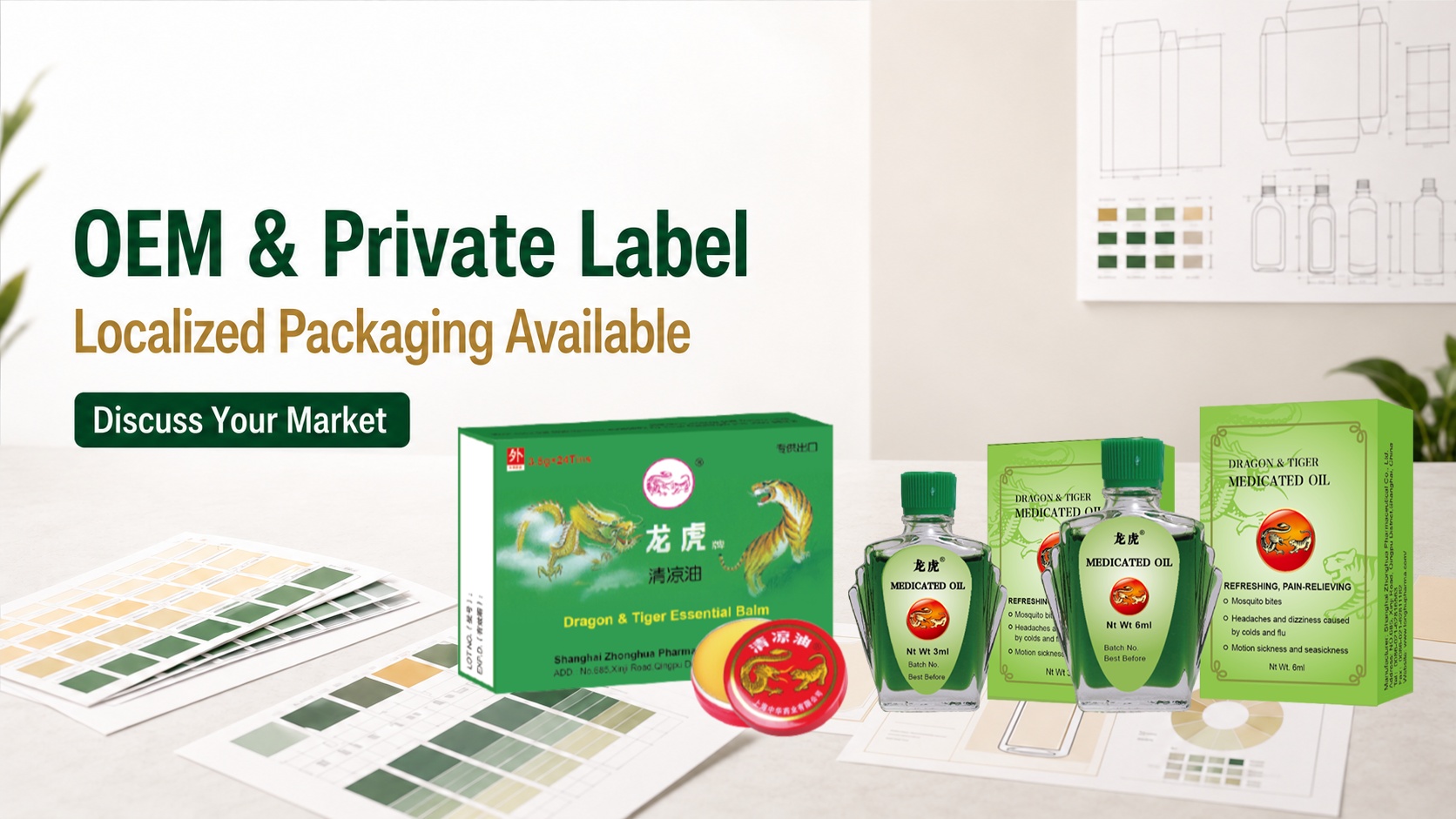
An OEM manufacturer produces a topical product to a buyer's specification and applies the buyer's brand to it. For essential balm, medicated oil and cooling products, the deliverable is rarely just filled tins.
A complete project usually covers four layers: the formula and its stability, the pack (tin, bottle, label, carton), the documentation that lets the goods clear customs and be registered in the destination country, and the production schedule that decides when stock reaches your warehouse. Buyers who plan all four at the start avoid the most common delay in this category, which is a finished batch waiting on an unapproved label.
Shanghai Zhonghua Pharmaceutical Co., Ltd. has manufactured cooling oils and balms since 1911 and runs OEM and private label projects alongside supply of its own Dragon & Tiger and Temple of Heaven brands. The sections below explain what a buyer controls, what sets order size and delivery timing, and what to confirm before committing, with the conditions that apply to African and Middle Eastern markets.
Why Source From an Essential Balm Manufacturer in China
China's advantage in this category is not a single factory but a complete chain: menthol and camphor supply, metal tins and glass bottles, label printing, and long experience of export documentation for topical products. Buyers sourcing essential balm for wholesale distribution usually need all four at the same time.
Shanghai Zhonghua Pharmaceutical was established in 1911 and is one of the first national pharmaceutical industry enterprises in modern China. Its manufacturing and brand base covers essential balm, medicated oil, cooling mint essential oil, cooling nasal inhalers, wind oil essence, Ren Dan pills and personal care products. The company reports customers in more than 100 countries and regions.
Length of operation matters for a specific reason: formulations that have been in production for decades carry a stability history, and packaging formats that have shipped to tropical and arid markets have already been tested by freight. It does not replace verification. Before placing an order, confirm the legal manufacturing entity, the site that will actually fill your batch, and the documents the factory can issue for your product category.
Private Label Medicated Oil Manufacturing: What the Buyer Controls
Private label means the product carries your brand rather than the factory's. Within that, control is split between the two sides.
What buyers normally specify:
- Formula direction — the ingredient set and the sensation profile, whether warming, cooling, camphor-forward or menthol-forward, within what the factory can legally produce and ship.
- Unit size — 3 ml, 6 ml, 3.5 g, 18.4 g and larger household sizes all exist for a reason; size drives both the retail price point and freight cost per unit.
- Packaging style — tin, glass bottle, plastic bottle, individual paper envelope, display carton.
- Label language and artwork — including mandatory statements in the language your market requires.
- Quality standard — the specification a batch must meet before it is released.
What stays with the manufacturer: process parameters, in-process controls, batch records and release testing. A private label buyer can usually specify the formula, but the factory still applies its own quality gates, because the release decision belongs to the licence holder of the manufacturing site.
Two routes are common. The first is producing to the customer's own formula and quality control standards. The second is adapting a formulation that is already in production, which is faster because the stability and process history exist. The trade-off is differentiation against time to market.
Essential Balm Private Label: Matching Formats to Retail Channels
Format choice should follow the shelf rather than the factory catalogue. A few patterns repeat across export markets.
- 3.5 g tins — the classic entry size. Low unit price, high rotation in kiosks, convenience stores and market stalls, and the format most often bought for wholesale distribution.
- 18.4 g balm — household and family use, a higher ticket, better margin per unit for pharmacies and supermarkets.
- 3 ml and 6 ml medicated oil — pocket and travel use; roll-on and dropper variants suit pharmacy counters.
- Deluxe packaging with individual envelopes — gift and pharmacy chain positioning; it costs more per unit and slows packing, so it needs volume to justify.
- Larger liquid formats — cooling water and household preparations for family use.
A common mistake is launching several sizes at once. Every additional SKU multiplies artwork approvals, component orders and quality documentation. For a first private label order in a new market, one or two sizes is usually the cheaper way to learn what sells.
Custom Essential Balm Packaging: Tins, Bottles, Labels and Cartons
Packaging decisions in this category are engineering decisions as much as design decisions.
Primary pack. Metal tins protect the balm well and cost little, but they dent. Glass presents the oil well and carries weight. Plastic is lighter and survives rough handling, with a different premium perception. The choice interacts with climate: in high-heat markets, seal integrity and product consistency in storage matter more than shelf appearance.
Closure and seal. Induction seals, shrink bands and tamper-evident caps are the usual options. Which one you need depends on how the goods will be handled between the port and the retail shelf.
Label. Language, mandatory warnings, net content, and batch and expiry format are set by the destination market's rules, not by the design file. Approve artwork against those requirements before plates are made.
Outer carton. Carton strength and units per carton affect damage rates in sea freight and inland trucking. For markets with long inland legs, a stronger carton is usually cheaper than the loss it prevents.
The practical sequence is: confirm the pack concept, confirm artwork and language, then confirm component availability. Component lead time frequently sets the project date, because tins, bottles and printed cartons come from suppliers outside the filling line.
Essential Balm MOQ: What Sets the Minimum Order Quantity
There is no single minimum order quantity for essential balm. Any figure quoted before your specification is known is an assumption. In practice the minimum is set by five cost drivers, and each can be discussed separately.
| Cost driver | Why it raises the minimum |
|---|---|
| Packaging components | Tins, bottles and caps are purchased in supplier minimums that are often higher than the filling run itself. |
| Printed labels and cartons | Print setup and plate costs are fixed, so they are spread across more units as volume rises. |
| Custom formula development | Development, sampling and stability work must be recovered across the order. |
| Number of SKUs | Each size and variant carries its own changeover, artwork and documentation. |
| Testing and registration support | Stability testing and market-specific documents are per-project work rather than per-unit work. |
Because these drivers differ by project, minimum order quantity, development cost and delivery time are confirmed for each individual project rather than published as a fixed number. The practical approach for a buyer is to send the specification first and ask for the minimum at that specification, then test whether a different pack size or a shared component lowers it.
Medicated Oil Production Lead Time: The Stages That Set the Date
Delivery dates in this category slip for predictable reasons. Understanding the stages makes the date negotiable instead of mysterious.
- Specification and feasibility. Formula direction, unit size, pack type and market requirements are reviewed together. Vague briefs are the main cause of repeated sampling.
- Sampling. A sample is produced and shipped for your approval and, where required, for laboratory testing in your market.
- Stability and compliance work. Where a new formula is involved, this stage usually decides the calendar; for formulations already in production it is shorter.
- Artwork and component procurement. Label approval plus tin, bottle and carton supply. This runs in parallel with production planning where possible and is often the step that can be pulled forward.
- Production and in-process control. Filling, sealing, labelling and packing, with quality checks during the run.
- Release testing and documentation. Finished product inspection, batch records, certificate of analysis, and shipping documents.
- Booking and freight. Sea freight adds transit time that varies by route and season.
If a launch date is fixed, work backwards from it and confirm which stage has the least slack. In most projects that is either artwork approval or stability testing, not the filling line.
Essential Balm Quality Control: What Happens Before a Batch Is Released
Quality management in this category starts before production. Shanghai Zhonghua Pharmaceutical describes a process that begins with supplier management, continues through material acceptance and inspection, controls the parameters of the production process, and releases finished goods only after inspection.
The supporting procedures named by the company cover continuous stability inspection, deviation handling, change control, corrective and preventive action, and quality risk management.
For a buyer, each of these maps to a document worth requesting:
- Product specification — what the batch is measured against, including appearance, odour, weight and fill.
- Certificate of analysis — the actual result for the batch you receive, not a generic template.
- Stability data — how the product behaves under the storage conditions your market will impose.
- Change control notification — an agreement that formula, supplier or packaging changes are communicated before shipment, not discovered on arrival.
None of this replaces a factory audit if your market requires one, but it separates suppliers who can answer these questions from those who cannot.
Supplying Essential Balm to African Markets
African markets are not one market, and the differences that matter are administrative and climatic rather than commercial.
Registration and documentation. Import requirements for topical medicated products vary by country, and several markets require product registration before the first shipment. The company has handled a West African distributor project focused on meeting import compliance requirements for essential balm, which is the stage most new importers underestimate.
Language. English, French and Portuguese markets need different labels. Producing one label for all three is rarely acceptable.
Climate and pack. Heat and humidity stress both product and packaging. Tins can corrode, labels can lift, and balm texture can soften in transit. Seal choice and carton strength are worth more attention here than in temperate markets.
Unit economics. Small units sold through kiosks and market stalls dominate volume in many countries, so price per unit and carton cube drive the landed cost more than the ex-works price.
Route and transit. Inland legs can be longer than the sea leg. That changes how much protection the outer carton needs and how much buffer stock a distributor should carry.
Medicated Oil for Middle East Markets: What to Confirm Before Ordering
The Gulf and wider Middle East reward preparation on three points.
Label and language. Arabic labelling is normally required alongside English. Text direction, font size and the placement of mandatory statements affect the artwork, so confirm them before design approval.
Registration per country. Requirements differ between GCC states and between categories of product. A product accepted in one market is not automatically accepted in the next, so confirm the registration path for each destination separately.
Format preference. Inhalers, roll-on oils and compact balms are widely used in the region, and pack formats that suit pharmacy and supermarket shelves differ from those that suit small retail.
Halal and other certifications. Where a certificate matters to your customers, ask the factory to confirm in writing what it holds and which product lines are covered. Do not assume a certificate exists because a market expects it.
Heat. Storage temperatures in summer are high. Stability data at elevated temperature is more relevant than shelf appearance when selecting a formulation.
Wholesale, Private Label or Regional Brand Agency: Choosing the Model
There are three workable ways to buy from an established manufacturer, and they suit different stages of a distribution business.
| Model | What you get | Best fit |
|---|---|---|
| Existing brand wholesale | Proven products under Dragon & Tiger or Temple of Heaven branding, with existing pack formats | Distributors testing demand before investing in their own brand |
| Private label / OEM | Your brand, your pack, your specification, produced to your quality standard | Importers with channel access who want margin and brand control |
| Regional brand agency | Authorisation to represent an existing brand in a territory, with brand support | Distributors able to commit to territory development |
The sequence that usually works: start with existing brand products to establish sell-through and learn the regulatory path, then move to private label once volumes and channel mix are known. Going straight to private label is viable when the buyer already controls distribution in the category.
What to Prepare Before Requesting a Quotation
A clear brief shortens sampling and reduces cost. Prepare the following before contacting a manufacturer:
- Target countries and sales channels.
- Product category and, if relevant, the formula or ingredient direction.
- Preferred unit size and packaging format.
- Brand, label language and artwork status.
- Expected order quantity and order frequency.
- Quality standard and any certification your market requires.
- Required delivery window.
- Registration status in the destination market, if already started.
With these eight items on the table, feasibility, samples, commercial terms and production dates can be discussed in one round instead of five.


